
14-08-2026
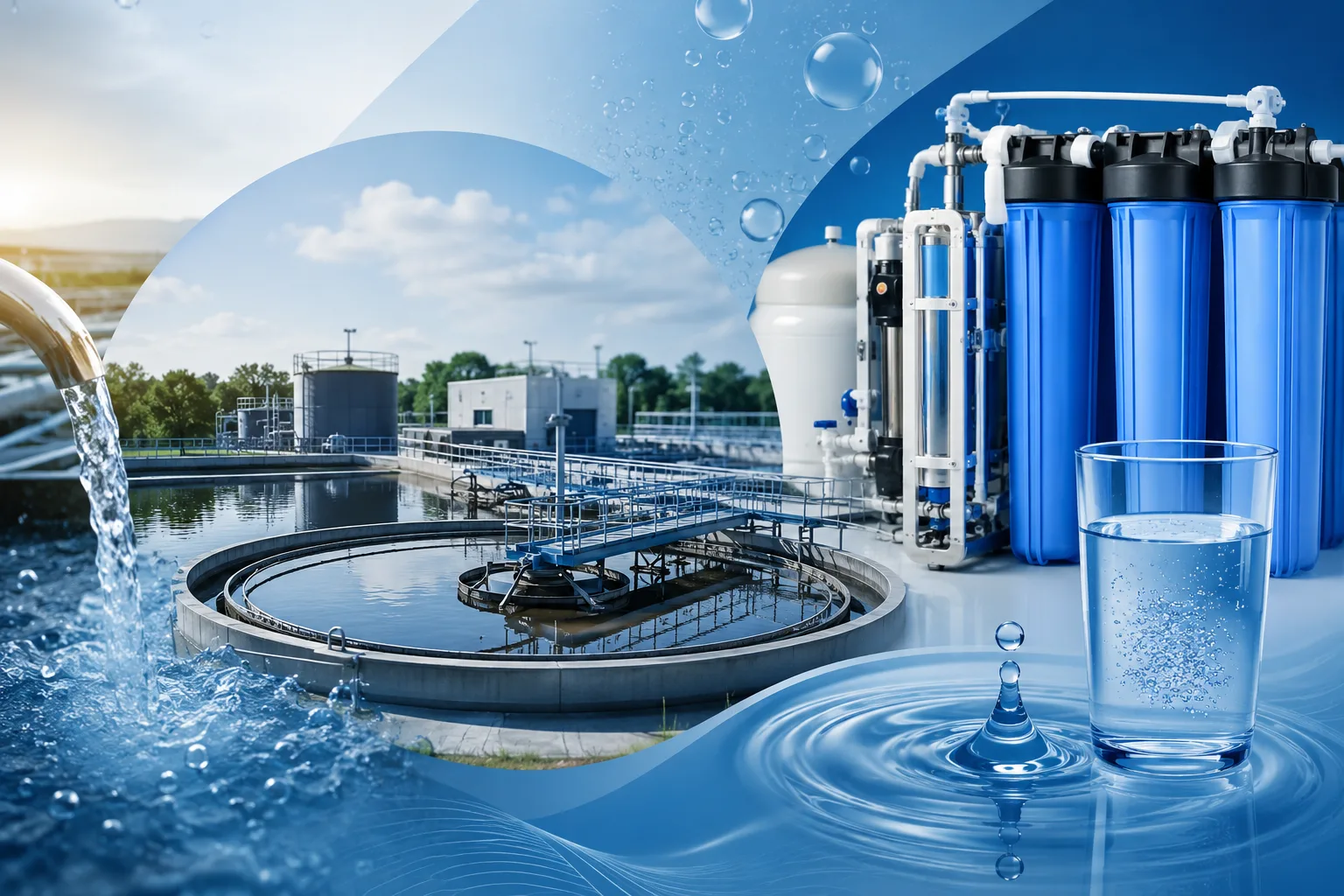
Water Treatment Technologies: A Closer Look at Types, Benefits, Applications & Comparison
3. Water Treatment Plant (WTP)
Ultrafiltration and Ultraviolet treatment are different technologies with different functions.
Ultrafiltration and Ultraviolet treatment are different technologies with different functions.
| Technology | Main Purpose | Main Function | Typical Application |
|---|---|---|---|
| RO | Membrane purification | Reduces many dissolved substances | Commercial and industrial purification |
| UF | Membrane filtration | Removes many suspended and larger contaminants | Filtration and pretreatment |
| UV | Disinfection | Controls microorganisms | Water disinfection |
Reverse Osmosis (RO)
Reverse osmosis uses a semipermeable membrane to remove a substantial amount of dissolved solids from water. RO is effective in cases where water has high solids or other dissolved matter. RO is commonly used in commercial and industrial water purification applications.
Ultrafiltration (UF)
Ultrafiltration uses membrane filtration to separate suspended particles, colloids and larger contaminants. It can be used as an independent method for the suitable applications or as a stage of pretreatment for other membrane systems.
Ultraviolet (UV) Treatment
UV treatment is primarily a disinfection process that utilizes UV radiation to inactivate microorganisms. UV does not remove dissolved salts, hardness or suspended matter from water. RO, UF and UV can sometimes be used together as stages in a comprehensive water treatment system.
MBBR, MBR and SBR: Understanding the Key Differences
Biological treatment is an important part of many wastewater treatment systems. Technologies such as MBBR, MBR and SBR use different approaches to biological wastewater treatment.
| Feature | MBBR | MBR | SBR |
|---|---|---|---|
| Full form | Moving Bed Biofilm Reactor | Membrane Bioreactor | Sequential Batch Reactor |
| Treatment method | Biofilm-based biological treatment | Biological treatment + membrane filtration | Cyclic biological treatment |
| Operation | Generally continuous | Generally continuous | Batch/cyclic |
| Membrane required | No | Yes | No |
| Space requirement | Can be compact | Often compact | Depends on design |
| Main consideration | Wastewater characteristics | Treated-water quality and space | Flow pattern and capacity |
The selection of treatment plans depends on:
• Wastewater characteristics
• Treatment capacity
• Available space
• Required treated-water quality
• Energy requirements
• Maintenance requirements
• Water reuse objectives
How to Choose the Right Water Treatment System Choosing a treatment system should begin by understanding the actual water or wastewater problem.
1. Test the Water
Water or wastewater analysis can help identify important parameters such as:
• pH
• TDS
• Turbidity
• Hardness
• BOD
• COD
• Suspended solids
• Microbiological parameters
2. Identify the Water Source
The treatment requirement can vary depending on whether the source is:
• Groundwater
• Borewell water
• Surface water
• Domestic sewage
• Industrial wastewater
• Process water
3. Determine Treatment Capacity
The treatment plant should be designed according to the quantity of water or wastewater generated. Both average and peak flow requirements may need to be considered during the design process.
4. Consider the Intended Use
The required treatment level depends on how the treated water will be used.
Potential applications can include:
• Flushing
• Gardening
• Cleaning
• Cooling
• Industrial processes
• Other suitable reuse applications
5. Consider Available Space
Space availability can influence technology selection. Some treatment systems can be designed with compact configurations, while others may require more area.
6. Consider Maintenance
Treatment plants require regular inspection and maintenance. Equipment such as pumps, blowers, membranes and electrical systems should be monitored according to the system design and operating requirements.
Importance of Water Treatment Plant Maintenance Installing a treatment plant is only the first step. Regular maintenance is important for maintaining treatment performance and identifying potential equipment problems.
Maintenance may include:
• Pump inspection
• Blower inspection
• Electrical checks
• Membrane monitoring
• Cleaning
• Aeration-system checks
• Sludge management
• Process monitoring
• Preventive maintenance
United Water Treat Technologies also offer Annual Maintenance Contract services to ensure the proper functioning of the equipment.
Regular maintenance increase the system reliability, performance, and prevent unexpected breakdowns.
Water and Wastewater Treatment in Ernakulam has a diverse mix of residential communities, commercial establishments, healthcare facilities, hotels and industrial units. Each type of facility can have different water and wastewater treatment requirements. This is why water and wastewater treatment in Ernakulam should be planned according to the individual requirements of the facility rather than using the same treatment process for every application.
Frequently Asked Questions
1. What are the main types of water treatment technologies?
Common technologies include STP, ETP, WTP, RO, UF and UV. Biological wastewater treatment technologies such as MBBR, MBR and SBR are also used for different applications.
2. What is the difference between STP and ETP?
STP is primarily designed to treat domestic sewage, while ETP is mainly designed to treat industrial wastewater.
3. What is the difference between RO and UF?
RO is mainly used to reduce many dissolved substances, while UF primarily separates suspended particles, colloids and larger contaminants.
4. Is Ultraviolet Treatment (UV) enough for complete water treatment?
UV is primarily designed for disinfection purposes. It does not remove dissolved salts or suspended matter from water, therefore it is necessary to undertake additional steps for
water treatment depending on the water quality.
5. Which wastewater treatment technology is best?
There is no universally best technology. The most optimal solution depends on a variety of factors such as wastewater characteristics, capacity, available space, treated-water requirements and maintenance considerations.
6. Can treated wastewater be reused?
Treated wastewater can potentially be reused for suitable applications when it meets the required quality criteria. The appropriate reuse application should be determined according to the treatment process and applicable requirements.
Water Treatment Services in Ernakulam and Trivandrum
United Water Treat Technologies provides water and wastewater treatment services in Ernakulam and Trivandrum for residential, commercial and industrial requirements. The company offers treatment solutions including sewage treatment, effluent treatment, water purification, membrane filtration, disinfection and maintenance services.
For businesses looking for water treatment technologies in Trivandrum, United Water Treat Technologies can provide solutions based on water quality, wastewater characteristics, capacity and the specific requirements of the project.
Get in touch with United Water Treat Technologies for your water or wastewater treatment
needs and explore the options suited to your requirements.
Latest Blogs
UV Water Treatment: How UV Water Purifiers and RO-UV Filtration Systems Help Improve Water Quality
Water Treatment Technologies: A Closer Look at Types, Benefits, Applications & Comparison
Water Treatment Solutions: Choosing the Right Partner for Your Enterprise

Drink with Assurance: The Top 10 Water Purification Techniques
